
.png)
We love words.
We just don’t love stopping every five minutes to look one up.
Dictionary apps technically solve that, but they also murder your reading vibe in cold blood.
Let’s talk about why WordFlow and dictionary apps live in completely different universes.
You’re reading a beautiful sentence, soaking up the story, and suddenly:
What does “obsequious” mean again?
You grab your phone, open your dictionary app, get your answer…
and five minutes later you’re on Instagram, wondering where the plot went.
You learned one word.
You lost your flow.
Dictionary apps are built for reference, not reading.
They interrupt your story, isolate the word, and serve it to you like sterile data.
Definition. Pronunciation. Example sentence.
Done.
Your brain doesn’t connect that word to anything meaningful, so it forgets it as fast as you looked it up.
It’s efficient, sure.
But it’s like learning to dance by reading sheet music.
WordFlow doesn’t wait for you to get stuck.
It predicts which words your next book will throw at you and teaches them before you start reading.
By the time you hit “obsequious”, your brain goes:
“Ah yes. That’s that overly flattering guy. Moving on.”
No dictionary detours. No mental friction. No lost flow.
When you preview new words before you read, you’re priming your Reticular Activating System (RAS) — the part of the brain that decides what deserves your attention.
So when you encounter those words later, your RAS lights up with recognition.
Your brain loves being right, dopamine fires, and boom — retention skyrockets.
You’re not memorizing definitions.
You’re reinforcing context.
That’s how learning becomes effortless.
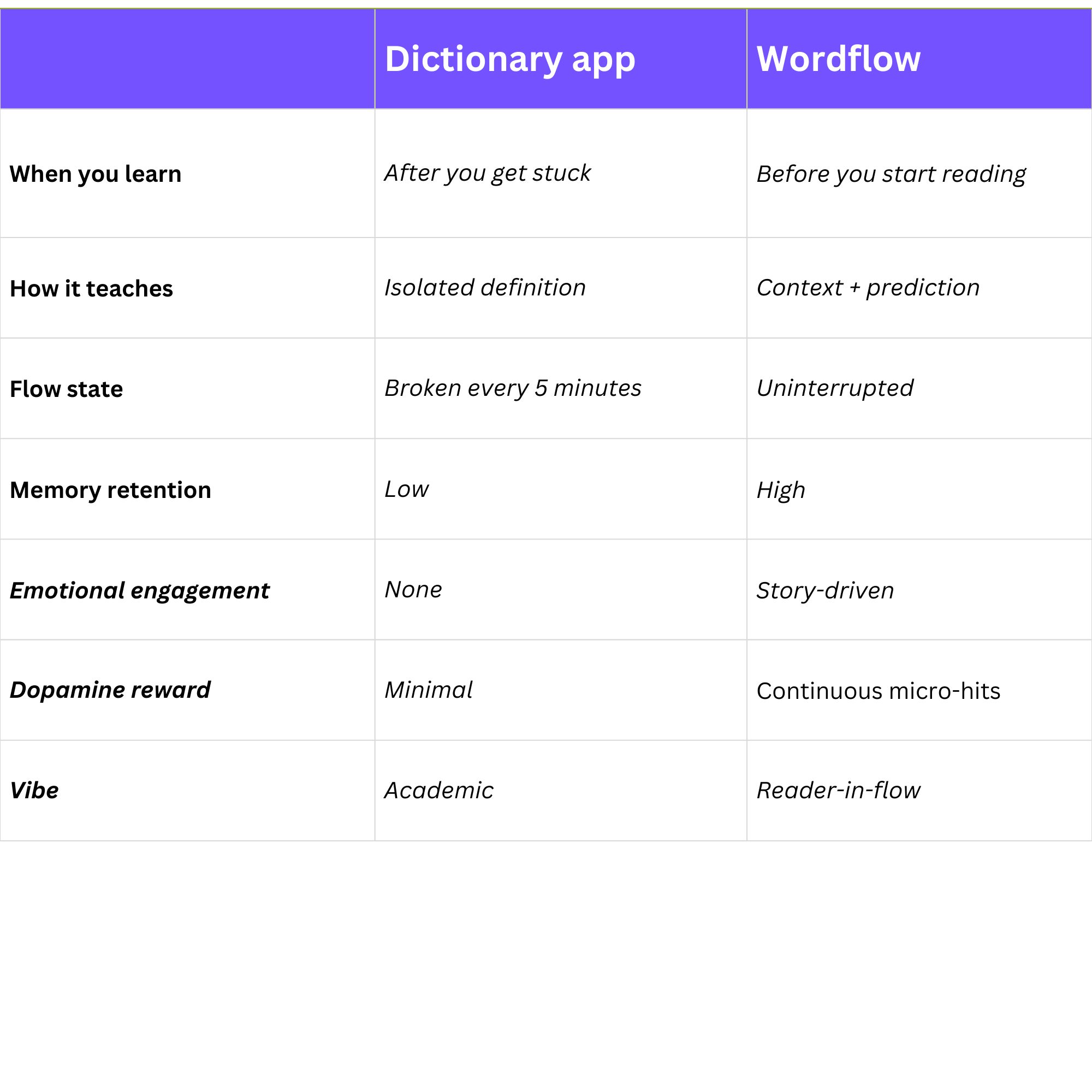
Dicionary apps help you understand a word.
WordFlow helps you own it.
One tops your story.
The other keeps it alive.
If ycou read to finish books, use a dictionary.
If you read to flow through them, use WordFlow.
👉 Try WordFlow
and see what reading feels like when learning doesn’t interrupt it.
Suggested reading: Stop Googling Words While Reading (and Start Actually Enjoying the Book)